Writing music scores on Hugo blog posts with ABCJS

Since I am on a roll with cleaning up my Hugo-based blog, adding alt text, and supporting math writing, I also had to experiment with adding support for musical scores. For the Sensing Sound and Music book, I used music21 in Python after struggling to set up LilyPond. Both LilyPond (professional engraving) and music21 (symbolic analysis and MIDI generation) are powerful and could be integrated into a blog, but they usually require a server-side toolchain or extra installation. However, with the help of CoPilot, I discovered ABCjs, a lightweight client‑side library that provides rendering, playback, and MIDI export, which work well for static sites. ...


January 2, 2026 · 2 min · 290 words · ARJ

Reflections on writing a textbook with AI

This semester, I have written a book with AI. I should emphasize the with in the previous sentence, because this has been an experience of co-creation between various large language models (LLMs) and me. This post details my approach to co-writing Sensing Sound and Music and reflects on the process. The need for a book The reason for my AI-based writing experiment was the need for a textbook for the course MUS2640 – Sensing Sound and Music at the University of Oslo. This is an introductory course for the bachelor’s students in our musicology program who want to major in music psychology and/or music technology. These are two distinct directions that are usually taught separately. However, at UiO, we have a strong tradition of combining psychological and technological perspectives on and with music (in the fourMs Lab and at RITMO), so I have argued that we need a foundation course showing the connections between the two disciplines. ...

December 22, 2025 · 12 min · 2495 words · ARJ

What should a PhD dissertation look like?

I am supervising several PhD fellows at the moment and have found that I repeat myself in the one-to-one meetings. So I will write blog posts summarizing general advice I give everyone. This post deals with what a PhD dissertation should look like. The classic Ph.D. dissertation Dear PhD fellow (in Norway, PhD fellows are employees, not students): All dissertations are different, yours included. You can write it however you want as long as it is good! It will be evaluated by people like me—experts in the field—often with long experience in supervising and reviewing dissertations. There is no right or wrong; go for something “safe” unless you feel incredibly confident. Your dissertation is not the place to experiment with weird things. ...

September 21, 2023 · 6 min · 1211 words · ARJ

Should I publish proceedings papers or journal articles?

I often get asked whether one should aim for proceedings papers or journal articles. Interesting question. If you ask people in the humanities or psychology, they would argue against proceedings papers. However, for informatics researchers, it is the default (journal articles are rare). I encourage publishing in both. If you have a short story that is worth telling quickly, definitely go for a proceedings paper. It counts as a real publication, it will be cited, and it will seem perfectly normal to anyone close to computer science. The time from writing to publication will also be much shorter. ...

January 13, 2023 · 1 min · 149 words · ARJ

An object-action-context approach to writing alt text

I came across an interesting blog post by Alex Chen on how to write better image descriptions for web pages. They propose an “object-action-context” approach when writing image descriptions. I see that such an approach could also be helpful for my sound actions project. Adding better descriptions I am soon getting to the end of my year-long project of recording one sound action daily. A sound action is a multimodal entity consisting of body motion and its resultant sound. My starting point is that when we only see a sound action, we can imagine its sound. If we only hear a sound action, we can imagine the body motion and objects involved in the interaction. Here is the playlist with all the recorded sound actions: ...

December 22, 2022 · 3 min · 482 words · ARJ

Exploring Essay Writing with You.com

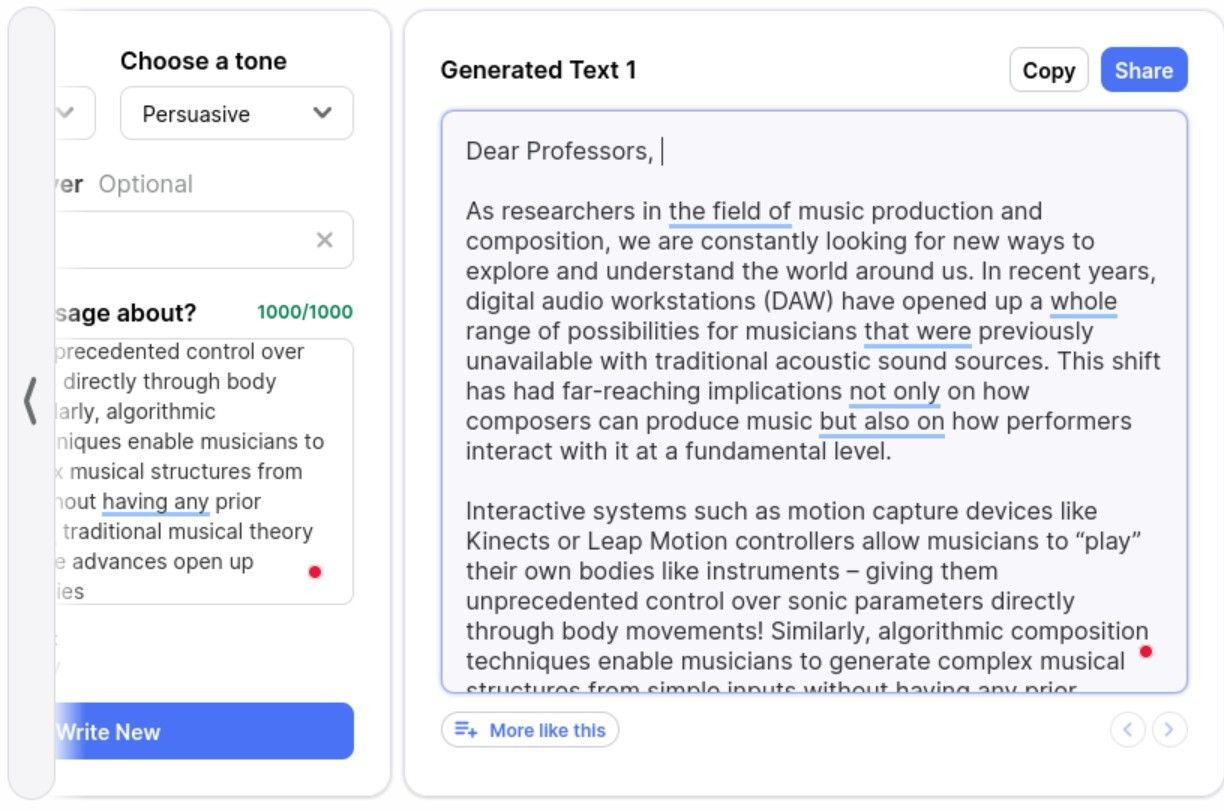
There has been much discussion about ChatGPT recently, a chat robot that can write meaningful answers to questions. I haven’t had time to test it out properly, and it was unavailable when I wanted to check it today. Instead, I have played around with YouWrite, a service that can write text based on limited input. I thought it would be interesting to ask it to write about something I know well, so I asked it to write a text based on an abbreviated version of the abstract of my new book: ...

December 16, 2022 · 7 min · 1431 words · ARJ

Still Standing Manuscript in Preparation

I sent off the final proofs for my Sound Actions book before the summer. I don’t know when it will actually be published, but since it is off my table, I have had time to work on new projects. My new project AMBIENT will start soon, but I still haven’t been able to write up all the results from my two projects on music-related micro-motion: Sverm and MICRO. This will be the topic of the book I have started writing this summer, with the working title Still Standing: Exploring Human Micromotion. ...

August 24, 2022 · 2 min · 226 words · ARJ

How to use quotation marks in academic writing

Quotation marks are used for different things in texts. Sometimes they are used to mark actual quotations, things that people have said and written. Other times they are used to mark a word, such as this is “funny”. Some people also use them to Single vs double quotes There is not a right or wrong when it comes to using single (’) or double (") quotes. Different style guides say different things, so use whatever is suggested. In any case, the most important is being consistent. ...

November 10, 2021 · 1 min · 146 words · ARJ

The Musicking Quadrant

I have been working on my new book (working title “Sound Actions”) over the summer. It mainly focuses on instruments, and I have struggled to find an analytic lens to explain how “instruments” are changing due to new (music) technologies. Now, I have come up with the concept of a musicking quadrant that summarizes four main types of musical activities: composing, performing, perceiving, and analyzing: ...

August 10, 2021 · 1 min · 173 words · ARJ

Sound Actions Manuscript in Preparation

Ever since I finished my dissertation in 2007, I have thought about writing it up as a book. Parts of the dissertation were translated and extended in the Norwegian-language textbook Musikk og bevegelse (which, by the way, is out of print but freely available as an ebook). That book focused primarily on music-related body motion and was written for the course MUS2006 at the University of Oslo. However, my action-sound theory was only partially mentioned and never properly presented in a book format. ...

July 23, 2021 · 2 min · 401 words · ARJ